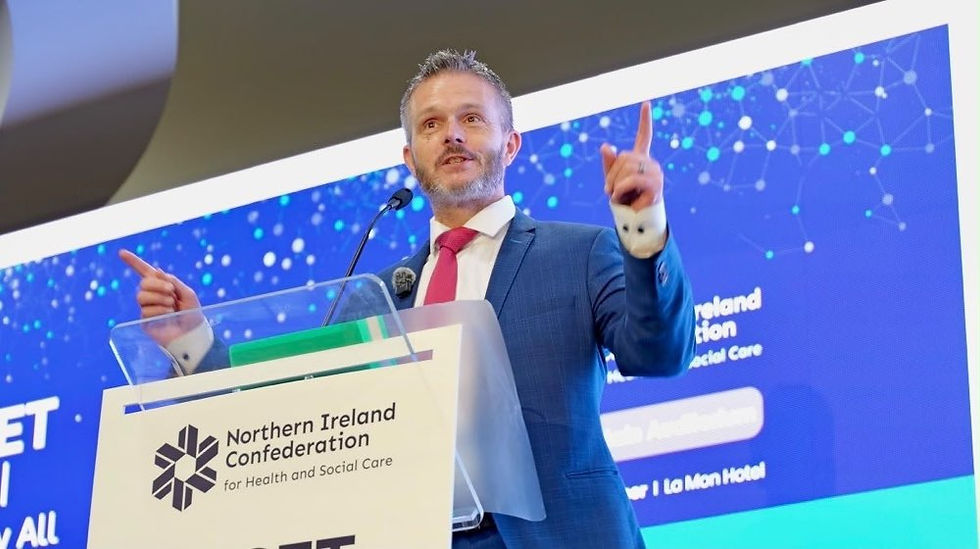
Robbie Butler set to become Northern Ireland’s new Health Minister


Ulster Unionist Party MLA Robbie Butler
Ulster Unionist Party MLA Robbie Butler is set to be confirmed as Northern Ireland’s new Health Minister, taking over one of Stormont’s most demanding roles following Mike Nesbitt’s resignation.
The Lagan Valley representative will inherit responsibility for a health service facing severe waiting-list pressures, difficulties accessing primary care and continuing controversy over the future configuration of hospital services.
Among his most immediate and politically sensitive decisions will be the proposed centralisation of emergency general surgery at Antrim Area Hospital—a dispute that contributed directly to Mr Nesbitt leaving the Executive.
Mr Butler’s formal confirmation is expected shortly.
Experienced MLA chosen for health brief
Mr Butler has represented Lagan Valley in the Northern Ireland Assembly since 2016 and previously served as deputy leader of the Ulster Unionist Party.
He currently represents the party on agriculture, environment and rural affairs and chairs the Assembly committee responsible for scrutinising those areas. He has also led for the UUP on mental health and young people.
Before entering politics, Mr Butler served for 16 years with the Northern Ireland Fire and Rescue Service and four years with the Northern Ireland Prison Service.
He was considered a possible contender to succeed Mike Nesbitt as UUP leader earlier this year but decided not to enter the contest, leaving Jon Burrows to be elected unopposed.
Mr Butler was subsequently replaced as deputy leader by Fermanagh and South Tyrone MLA Diana Armstrong.
Appointment follows dramatic resignation
Mr Nesbitt resigned as Health Minister on Tuesday evening following a significant disagreement with Mr Burrows over emergency general surgery at Causeway Hospital in Coleraine.
In his resignation letter, Mr Nesbitt accused the UUP leader of introducing a second political “red line” on health policy by backing the retention of emergency surgery at Causeway.
Mr Nesbitt wrote:
“This letter concerns the fact you appear to have introduced a second ‘red line’, regarding Emergency General Surgery at Causeway Hospital.
“I am not the sort of Minister who is happy to discover the Leader’s view of issues under my purview by having to monitor the media.”
He said the disagreement had created “shock waves” across the health and social care system before describing his time as Health Minister as the greatest privilege of his political career.
Causeway decision awaits new minister
The Northern Health and Social Care Trust has recommended consolidating emergency general surgery at Antrim Area Hospital while concentrating most planned general surgery at Causeway.
The proposal still requires a formal decision from the Department of Health and its minister.
The Trust has maintained that the existing model of providing emergency general surgery across Antrim Area and Causeway hospitals is becoming “increasingly unsustainable”, particularly because of difficulties maintaining 24-hour emergency surgical rotas at both sites.
An independent review conducted by the clinically led NHS improvement programme Getting It Right First Time in March 2026 found, according to the Trust, that the existing arrangement was not sustainable and that consolidation at Antrim was “clinically and operationally appropriate”.
However, the proposal has generated strong opposition across the Causeway Coast and north coast.
Campaigners and political representatives have raised concerns about longer journeys, ambulance capacity, additional pressure at Antrim Area Hospital and the possible wider consequences for Causeway Hospital.
Burrows promises reform will continue
Mr Burrows has said the UUP remains committed to health service transformation but acknowledged that the balance between clinical evidence, professional engagement and community confidence had not been right.
Addressing the Causeway controversy after Mr Nesbitt’s resignation, the UUP leader said:
“Clinical evidence must be central to decision making, but reform cannot simply be done to communities. There must be genuine engagement with the clinicians and staff delivering services and with the people who depend on them.
“I don’t believe we have got that balance right, and the strength of feeling around Causeway shows what happens when communities feel decisions are arriving rather than being made with them.”
Mr Burrows also promised that the change of minister would not interrupt work already under way to reduce waiting lists and improve access to GPs, emergency departments, diagnostics, treatment and surgery.
Major challenges awaiting Butler
Mr Butler will take responsibility for a department confronting pressures across almost every part of Northern Ireland’s health and social care system.
Alongside hospital reform, his priorities are expected to include reducing waiting lists, improving emergency department performance, stabilising the workforce and addressing unequal access to services between different areas.
His previous work on mental health will also bring expectations of continued focus on pressures affecting children, young people and community services.
The immediate test will be restoring stability to the Department of Health following Mr Nesbitt’s abrupt departure while deciding how to proceed with major service reforms already under consideration.
Mr Butler’s expected appointment resolves the immediate question of who will lead the Department. It does not resolve the disagreement at the centre of his predecessor’s resignation: whether emergency general surgery can be retained safely and sustainably at Causeway Hospital or should be consolidated at Antrim.