Robbie Butler confirmed as Northern Ireland’s new Health Minister


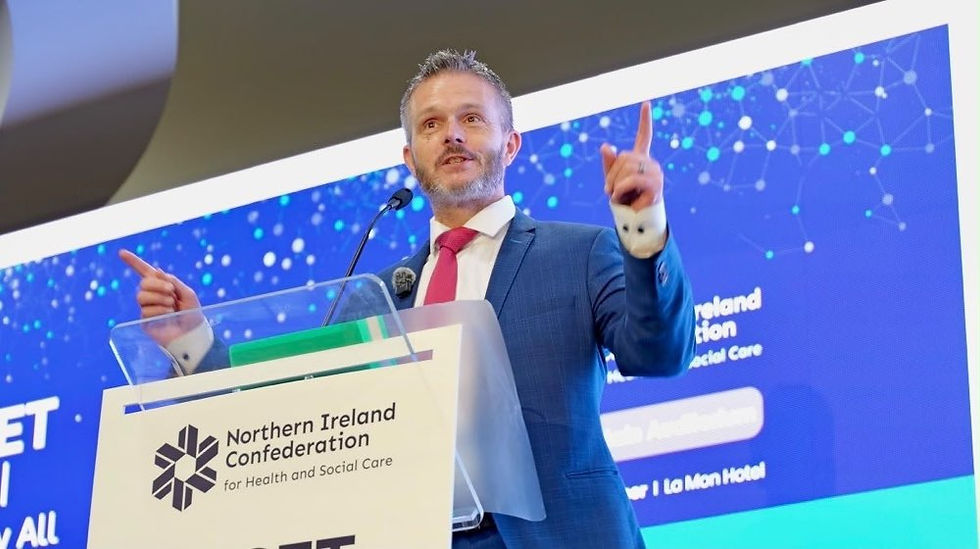
Causeway Hospital, and (inset) newly appointed Health Minister Robbie Butler
Robbie Butler has been confirmed as Northern Ireland’s new Health Minister, taking charge of a health and social care system facing severe waiting-list pressures and major decisions over the future of hospital services.
Ulster Unionist Party leader Jon Burrows announced the nomination on Thursday, less than two days after Mike Nesbitt resigned amid a political dispute over emergency general surgery at Causeway Hospital.
Mr Butler, a Lagan Valley MLA and former firefighter, said he had “no illusions” about the scale of the challenge and promised to listen to patients and frontline staff, make decisions and be accountable for them.
His appointment restores political leadership to the Department of Health, but also places responsibility for the unresolved Causeway Hospital proposal—and other contentious reforms—directly with the new minister.
Burrows says party acted ‘at pace’
Mr Burrows said the appointment delivered on his promise to move quickly following Mr Nesbitt’s departure.
The UUP leader said:
“I said yesterday that we would move at pace to provide the leadership our health service requires, and today we have done exactly that. I am pleased to announce the nomination of Robbie Butler as Northern Ireland’s next Minister of Health. He has my full confidence and the full backing of our Assembly team.
“The role of Health Minister is bigger than any one individual or party. At moments when the Executive has faced its most demanding challenges, this party has stepped forward, and we do so again today. Our commitment to patients, to health and social care staff, and to meaningful reform remains unbroken.”
Mr Burrows said the central challenge was not whether Northern Ireland could provide excellent healthcare, but whether patients could access it quickly enough.
He identified GP appointments, ambulance response times, diagnostic scans, consultant care and surgery as areas requiring attention.
“We will work with urgency to build a safer, faster, fairer and more sustainable health service, one that is quicker to access and delivers for everyone, no matter where they live in Northern Ireland,” he said.
‘Hope Not Fear’ approach
Mr Butler said his political approach had always been based on “Hope Not Fear”, a principle he connected to his 16 years in the Northern Ireland Fire and Rescue Service and his subsequent political career.
He has represented Lagan Valley in the Northern Ireland Assembly since 2016 and has previously served as UUP deputy leader.
Mr Butler said:
“My political mainstay has always been ‘Hope Not Fear’, and that is rooted in how I approached my 16 years in the Fire and Rescue Service and the past 10 years across my political brief. I want Northern Ireland to have a world-class health service that people can access more quickly.”
The new minister said decisions affecting people’s health and wellbeing must be shaped by clinical evidence, frontline experience, patients’ needs and the confidence of communities across Northern Ireland.
“There should always be one objective: to make things better for everyone. That is exactly the approach I will bring to this role,” he said.
That commitment to combining clinical evidence with community confidence will be closely examined when Mr Butler considers proposals affecting Causeway Hospital.
Causeway decision among immediate challenges
The Northern Health and Social Care Trust has recommended consolidating emergency general surgery at Antrim Area Hospital while concentrating most planned general surgery at Causeway Hospital in Coleraine.
The Trust maintains that the current model of delivering emergency general surgery across both sites is becoming “increasingly unsustainable”, partly because of the difficulty of providing continuous emergency surgical cover at both hospitals.
According to the Trust, an independent review by the clinically led NHS improvement programme Getting It Right First Time concluded that the current arrangement was not sustainable and that consolidation at Antrim would be “clinically and operationally appropriate”.
However, the proposal has faced strong public and political opposition across the Causeway Coast and north coast.
Concerns include longer journeys for patients, ambulance capacity, additional pressure on Antrim Area Hospital and the potential consequences for the wider range of services provided at Causeway.
Mr Burrows’ public support for retaining emergency general surgery at Causeway brought him into direct conflict with Mr Nesbitt and contributed to the former minister’s resignation.
A formal decision on the Trust’s proposal had not been made before Mr Nesbitt left office, meaning responsibility now passes to Mr Butler.
Tribute to health and social care staff
Mr Butler said he had witnessed the commitment of health and social care staff working under difficult conditions and recognised how heavily patients and families depended upon them.
“I see at close hand the extraordinary commitment of the people who keep our health and social care service running, often in the most difficult circumstances. I know what we ask of them, and I know how much patients and families depend on them.
“To now be asked to serve them as Minister of Health is an enormous privilege and an even greater responsibility.”
The new minister acknowledged that too many people were waiting too long for treatment while staff faced relentless pressure and services struggled to meet growing demand.
He cautioned that those problems could not be solved immediately but rejected the suggestion that they had to become permanent features of Northern Ireland’s health service.
“Those problems will not be solved overnight, and I will not insult people by pretending otherwise. But neither will I accept that they are inevitable,” he said.
Reform must make a visible difference
Mr Butler promised to bring urgency and a willingness to challenge existing approaches where necessary.
He said reform should not be confined to strategies, organisational changes or discussions about structures, but must produce improvements that patients can experience directly.
“Improvement and meaningful reform cannot simply be discussed in strategies or measured by changes to structures. People should be able to see and feel the difference in the care they receive.”
He described his intended approach as straightforward:
“Listen most to the people who deliver and use our services, take decisions and be accountable for them.”
Mr Butler also pledged to spend as much time as possible visiting frontline health and social care services rather than working solely from behind a desk.
He said this had been an important part of Mr Nesbitt’s approach and promised to build upon the momentum created by his predecessor while bringing his own priorities, ideas and energy to the role.
‘There is no time to waste’
Mr Nesbitt resigned on Tuesday evening after accusing Mr Burrows of introducing a second political “red line” by backing the retention of emergency general surgery at Causeway Hospital.
In his resignation letter, the former minister said the disagreement had created “shock waves” across the health and social care system.
The UUP thanked Mr Nesbitt for his service and highlighted his work on health inequalities, waiting lists and the development of a neighbourhood model of care.
Mr Butler now assumes responsibility for continuing that work while rebuilding stability following the abrupt change in leadership.
He concluded:
“This is an enormous responsibility, but it is one I take on with determination and optimism. There is no time to waste. I am ready to get to work.”
The appointment ends the immediate uncertainty over who will lead the Department of Health. Attention will now turn to the decisions Mr Butler takes—and whether his promise to listen to clinical staff, patients and communities can produce both sustainable reform and renewed public confidence.