


New chapter for Cushendall as plans to bring much-missed Glens Hotel back to life are approved


CGI showing the newly approved hotel in Cushendall
Thursday 29 October 2026
A landmark Cushendall hotel that has stood empty for around eight years could finally welcome guests again after councillors approved ambitious plans to transform it into a 38-bedroom destination with a restaurant, bar, function room and gym.
Causeway Coast and Glens Borough Council’s Planning Committee approved the major redevelopment of the former Glens Hotel on Coast Road on Wednesday evening, 28 October, marking a significant step towards restoring one of the village’s best-known hospitality venues.
The scheme will more than double the hotel's former accommodation capacity, increasing the number of bedrooms from 16 to 38, while bringing back facilities for dining, celebrations and community gatherings.
For Cushendall, where tourism is an important part of the local economy, the decision offers the prospect of new employment, additional visitor accommodation and renewed activity at a prominent property that has remained closed since approximately 2018.
Major transformation planned for former hotel
The redevelopment, brought forward by Z Property Development and GMR Architects, will retain and refurbish the main frontage of the existing building while substantially rebuilding and extending the property behind it.
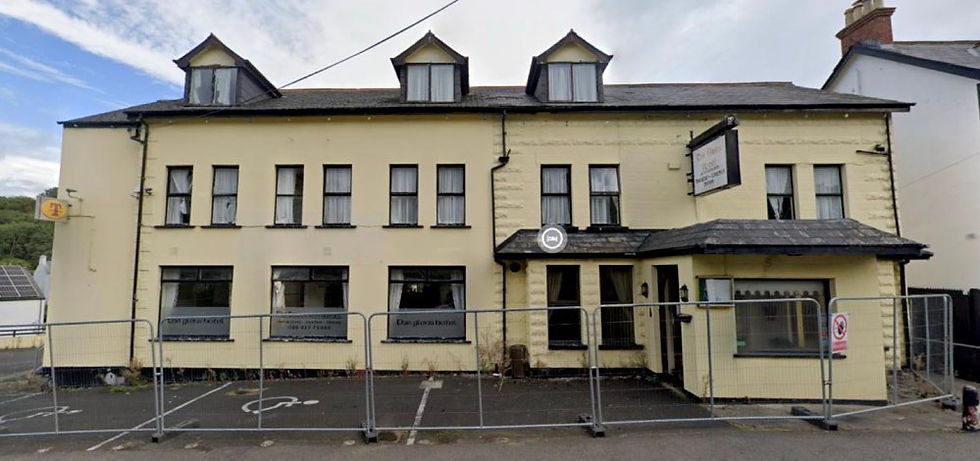
The derelict Glens Hotel in Cushendall
The current state of the interior of the derelict Glens Hotel in Cushendall

The approved proposals include:
• 38 guest suites across the first and second floors, with 19 on each level.
• A new public bar and restaurant, with separate entrances from Coast Road.
• A large function room for events and celebrations.
• A gymnasium and additional guest facilities on the lower ground floor.
• A spacious outdoor terrace to the front and a smaller terrace at the rear.
• A redesigned hotel entrance, reception and communal areas.
The project involves demolishing substantial portions of the existing rear and side extensions, including former kitchens, function spaces, storage areas and sections of the roof, to make way for the new facilities.
The hotel's prominent Coast Road frontage will be redesigned using traditional materials, including natural slate roofs, timber sash windows and smooth rendered walls, reflecting the architectural character of the surrounding village.
Planning officers concluded that the proposed development would enhance the appearance of the site while respecting Cushendall Conservation Area and nearby listed buildings.
Local councillor welcomes plans to restore much-missed hotel
Aontú councillor Margaret Anne McKillop was among those who submitted written support for the redevelopment, highlighting the importance of the former Glens Hotel to Cushendall and the wider tourism economy.
A lifelong connection to the village and her own experience working in hospitality informed her support for bringing the vacant building back into use.
Councillor McKillop said:
“This hotel has been vacant for many years, and this proposal would breathe new life into the property and provide another destination for people visiting the area.”
She highlighted the shortage of visitor accommodation in Cushendall and surrounding communities, arguing that the redevelopment could support existing businesses while creating new employment opportunities.
“This is a major investment for Cushendall and the wider area which will give locals not only an economic, but also employment boost.”
Reflecting on the hotel's importance to generations of local hospitality workers, she added:
“As a trained chef I know how valuable it is to have a hotel in your area, and like so many other people who trained and worked in the hotel, I was always glad of the experience of starting out in this hotel.”
Parking shortfall examined before approval
Despite the economic and tourism benefits identified by planning officers, the application attracted objections over parking, traffic congestion and road safety.
Under the relevant parking standards, a development of this size would require 182 spaces. However, the hotel proposals provide just two on-site disabled parking spaces, leaving the remainder of the parking requirement to be addressed through other arrangements.
The previous hotel had 11 on-site spaces, despite having a calculated requirement of 104 spaces under current standards. Planning officers acknowledged this existing shortfall but emphasised that the new development had to be assessed against its own parking requirements.
To help accommodate guests, a separate application has been submitted for a 24-space valet parking facility on Ballyemon Road, approximately 120 metres south-west of its junction with Coast Road.
Under the proposed arrangement, guests would leave their vehicles at the hotel, with staff transferring them to the off-site car park and retrieving them when required.
The hotel approval includes a condition preventing the redeveloped premises from becoming operational until the valet parking facility has been completed and is operating in accordance with the associated application. Its continued provision is also subject to a legal agreement.
Council accepts reduced parking provision

The application received eight letters of objection from four separate addresses, with concerns including congestion, road safety, the accuracy of parking surveys, public transport provision and the proposed valet service.
Parking studies undertaken in 2023 and 2025 were submitted in support of the development. The latest survey, carried out over Easter weekend in April 2025, identified at least 102 available parking spaces within the surveyed area at its busiest point.
However, planning officers acknowledged that the proposed arrangements would still fall short of the full parking standards, even taking the additional valet spaces into account.
DfI Roads raised no objection concerning road safety or access arrangements, although it highlighted concerns about the level of parking provision. The question of whether the reduced provision was acceptable was ultimately a matter for the council.
Officers concluded that existing on-street and public parking, together with the proposed valet service, would adequately serve the development without creating an unacceptable impact on traffic flow.
They also considered that the benefits of restoring a vacant hotel, improving the conservation area and supporting employment and tourism outweighed the parking shortfall.
A hotel that has been missed by the community

Among those supporting the redevelopment was Aontú councillor Margaret Anne McKillop, who described the importance of restoring a hotel that had once been a familiar part of village life.
In her written representation, Councillor McKillop said: “This hotel has laid vacant for many years, and this proposal would breathe new life into the property and provide another destination for people visiting the area.”
She highlighted the demand for additional tourist accommodation in Cushendall and the potential economic benefits for local businesses and residents.
“This is a major investment for Cushendall and the wider area which will give locals not only an economic but employment a boost.”
Councillor McKillop, who lives in Cushendall, also reflected on her personal connection to the former hotel, where she gained valuable experience in the hospitality industry.
“As a trained chef i know how valuable it is to have a hotel in your area and like so many other people who trained and worked in the hotel i was always glad of the experience of starting out in this hotel.”
The application attracted four letters of support from two addresses, alongside the eight objections and one additional comment.
Supporters pointed to the hotel's former role in hosting weddings and large functions, providing daily bar and restaurant facilities and creating employment opportunities.
They also argued that reopening the property could bring additional visitors and spending into the village and surrounding area.
Wastewater capacity remains an important condition

Although the redevelopment has secured planning approval, significant infrastructure requirements must still be addressed before the hotel can open.
NI Water identified capacity problems within the existing wastewater network, warning that additional sewage could pose risks to the environment and neighbouring properties unless adequate arrangements are established.
A Wastewater Impact Assessment has already been submitted and discussions with NI Water are ongoing. However, the assessment had not reached the stage necessary for final sign-off when the planning report was prepared, and no sewer connection date had been confirmed.
The planning conditions require the developer to demonstrate that the public sewer and receiving wastewater treatment works have sufficient capacity before construction progresses beyond the building foundations stage.
The hotel must also be connected to the public sewer before becoming operational, while an acceptable surface water drainage solution must be agreed before construction advances beyond sub-floor level.
These requirements mean that the council's decision does not, by itself, establish when construction can progress or when the hotel will be ready to reopen.
Restrictions to protect neighbouring homes
The approved development will also be subject to conditions designed to minimise disturbance to nearby residents.
These include acoustic glazing for the bar and function room, controls on noise from equipment, measures to limit cooking odours and restrictions on deliveries.
Amplified or relayed music will not be permitted outdoors, while heavy goods vehicle deliveries will be restricted to between 7am and 11pm.
Additional external lighting will require prior assessment and approval, with the development also required to follow an agreed lighting design to protect bats and other wildlife.
The council's Environmental Health team raised no objection subject to appropriate conditions addressing noise, odour, deliveries and lighting.
From years of uncertainty to renewed opportunity
The future of the Glens Hotel has been under consideration for several years, with an earlier pre-application proposal exploring the demolition of the vacant building and its replacement with a 17-apartment residential development.
The current hotel redevelopment plans emerged in 2023, when Love Ballymena reported on proposals by Z Property Development and GMR Architects to retain the site's traditional hospitality use rather than replace it with housing.
At the time, the project's Design and Access Statement warned that the existing structure was “rapidly falling into disrepair and is in need of early redevelopment before parts of the building become non-retainable”.
The statement also highlighted occasional vandalism and growing local concerns about the potential for anti-social behaviour at the vacant property.
Rather than demolishing the entire building, the approved scheme retains its principal historic frontage while introducing substantially expanded accommodation and modern hospitality facilities.
Planning officers considered that the redevelopment would improve a prominent site within Cushendall Conservation Area and reintroduce an established commercial and employment use to the village.
They also identified the potential for the hotel to act as an important local business, supporting tourism and further economic activity in an area where visitor spending is particularly valuable.
A significant step towards reopening
The Planning Committee's decision marks a major milestone for the Glens Hotel, although a construction start date, reopening timetable, final investment figure and number of jobs have not yet been confirmed.
The associated conservation-area demolition consent and separate valet parking application have their own planning processes, while the developer must also satisfy the relevant conditions attached to the hotel approval.
For a village that has been without the Glens Hotel for around eight years, the decision offers the prospect of restoring a familiar landmark, creating new employment opportunities and bringing visitors back through its doors. The challenge now is to resolve the outstanding infrastructure and parking requirements and turn the approved plans into a functioning hotel.


