CAFRE launches ‘Growers’ Gathering’ to drive innovation in peat-free horticulture
- Love Ballymena

- Dec 31, 2025
- 3 min read

Crop walks during the ‘Growers’ Gathering’ provided opportunities for useful discussions and viewing of implementation strategies in action at Greenmount Campus, Antrim.
The College of Agriculture, Food and Rural Enterprise (CAFRE) has launched a new series of industry-focused events with the inaugural Growers’ Gathering for Production Horticulture, bringing together growers, researchers and policymakers to address one of the sector’s most pressing challenges – reducing and ultimately replacing peat in horticultural production.
More than 50 growers, suppliers, students and key stakeholders attended the event at CAFRE’s Greenmount Campus in Antrim, reflecting strong interest across the industry in finding practical, sustainable alternatives to peat.
The gathering offered a dynamic programme of technical presentations, interactive question-and-answer sessions and hands-on demonstrations, designed to encourage collaboration and real-world innovation.
Learning Curve for a Changing Sector
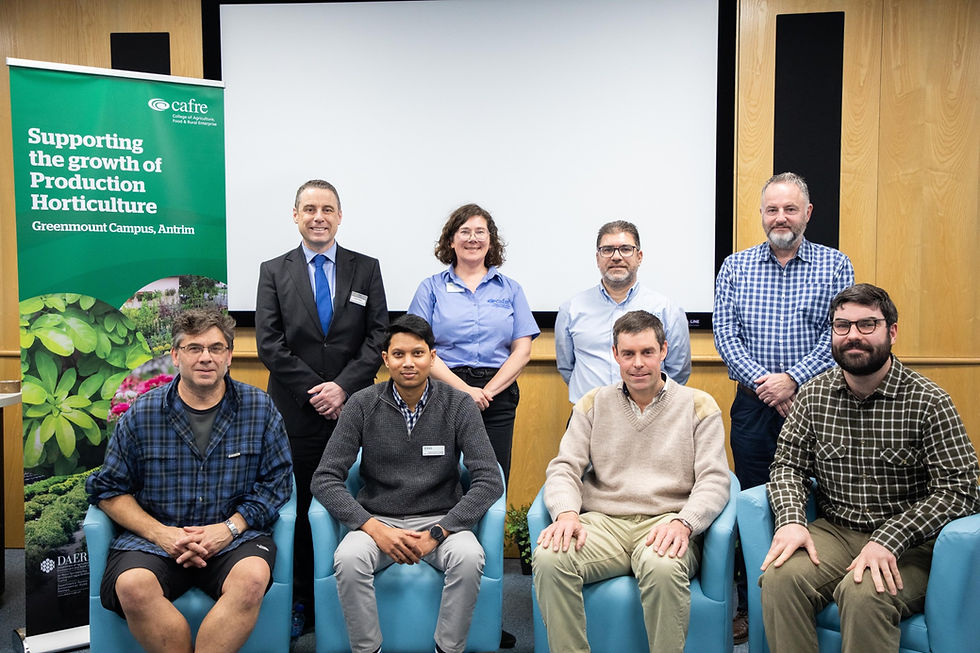
Guest speakers at the Growers’ Gathering: Front row - Dr Paul Alexander (Bulrush Ltd.), Dr Raghavendra Prasad (RHS), David Talbot (ADAS), Dr Eoghan Corbett (Teagasc). Back row - David Dowd (CAFRE), Lori Hartman (CAFRE), Dr Konstantinos Xyntaris (CAFRE), Mark Preston (DAERA).
The morning sessions set the tone, focusing on the scale of change facing the horticulture industry. Dr Paul Alexander of Bulrush Horticulture Ltd opened proceedings with an industry-led overview of the latest developments in peat-free growing media, highlighting both progress made and challenges still to overcome.
This was followed by Dr Raghavendra Prasad from the Royal Horticultural Society (RHS), who shared cutting-edge research supporting the transition towards 100% peat-free production across both commercial and domestic horticulture.
Together, the speakers underlined a clear message: after decades of reliance on peat, the sector is now on a steep learning curve.
Growers were encouraged to rethink long-established practices, trial new materials on their own sites and use experimentation and research to identify what works best within their individual systems.
Policy Commitments and Cross-Border Research
Policy considerations were also firmly on the agenda. Mark Preston from DAERA’s Peatland Policy team outlined the department’s commitments under the recently published Peatland Strategy, including plans to phase out peat use in horticulture by 2030.
The event provided a valuable forum for open discussion between policymakers and industry representatives navigating this transition.
Adding a cross-border dimension, Dr Eoghan Corbett from Teagasc presented insights from Beyond Peat, a collaborative research initiative supported by DAERA through the Agri-Food and Biosciences Institute (AFBI).
The project is investigating sustainable alternatives such as straw, wood fibres and green waste, with trials already underway in strawberry and mushroom production.
Practical Solutions on Display at Greenmount
A strong human and practical interest element came through during the afternoon demonstrations. Dr Konstantinos Xyntaris, Senior Horticulture Technologist at CAFRE, alongside Mark Huey, Horticulture Technologist, led attendees on a guided tour of the Greenmount Horticulture Centre’s demonstration plots.
Growers were able to see first-hand how peat-free solutions are being tested in real production settings.
Trials showcased included comparisons between conventional controlled-release fertilisers and blends incorporating waste-derived biofertilisers in containerised perennials, bedding plants and ornamental cabbage.
Visitors also viewed peat-free poinsettias produced under a ‘cold-grown’ regime, achieved by adjusting husbandry practices three weeks earlier, as well as successful production of tree seedlings grown in peat-free media within cell trays.
The tour concluded with an innovative season-extension strawberry trial, featuring a coir-based late autumn crop grown at the shoulders of the main season with minimal electricity inputs – a particularly relevant example for growers facing rising energy costs.
Supporting Growers to Adapt and Thrive
David Dowd, Acting Head of Horticulture at CAFRE, outlined the new Horticulture Pilot Scheme, highlighting two opportunities that remain open for applications.
The scheme aims to support innovation and sustainability within the sector by giving growers practical tools to adapt to change. Full details and application guidance are available at www.cafre.ac.uk.
Further practical insight was provided by David Talbot, Senior Horticulture Consultant at ADAS, who delivered an update on the use of bioprotectants for managing pests and diseases in ornamental crops. His presentation was followed by a guided walk through the Greenmount glasshouses, allowing attendees to see these strategies being applied in practice.
Looking Ahead
CAFRE has confirmed that further industry events and specialist courses are planned throughout 2026, continuing to support growers as they respond to environmental, economic and regulatory change.
Those interested are encouraged to keep up to date by checking the events section of the CAFRE website at www.cafre.ac.uk.
By combining research, policy insight and hands-on demonstrations, the first Growers’ Gathering has set a strong foundation for future collaboration, placing growers at the centre of the journey towards a more sustainable, peat-free horticulture sector.