


Born 12 weeks early, Catherine inspired her mother’s mission to help families facing neonatal trauma

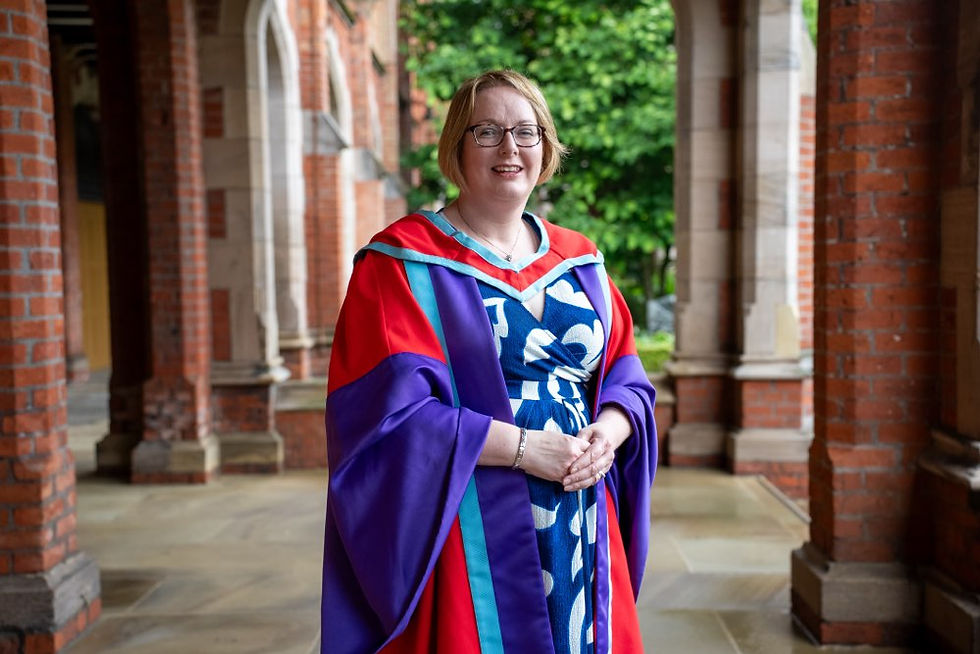
Victoria Craig from Broughshane, graduated on Monday, receiving her PhD in Nursing at Queen's
When Catherine Craig was born 12 weeks early at Antrim Area Hospital in 2006, her mother Victoria had no idea that the frightening weeks which followed would shape the rest of her life.
The tiny baby arrived at just 28 weeks and one day gestation following an emergency caesarean section and would spend the next 10 weeks in the hospital’s Neonatal Unit fighting through the earliest days of life.
For Victoria, then approaching the end of her nursing degree, the experience was traumatic, overwhelming and life-changing.
Twenty years later, today the Broughshane woman has graduated with a Doctor of Philosophy from the School of Nursing and Midwifery, having transformed her own experience into a lifelong commitment to helping other parents facing the same journey.
The local woman works as a clinical educator in the very same neonatal unit that once cared for her daughter, supporting premature babies, their families, nursing staff and students.
It is a remarkable full-circle story that began in one of the most difficult periods of her life.
A traumatic beginning that changed everything
Victoria remembers feeling supported by staff in the Neonatal Unit during Catherine’s early weeks, but says the emotional impact of the experience continued long after they left hospital.
Like many parents of premature babies, survival and day-to-day care became the immediate focus, with little time to process the trauma unfolding around them.
“Catherine’s birth was a very traumatic time in my life. I often say she changed my life in so many ways,” Victoria said.
“She was born by emergency c-section at 28 +1 weeks gestation, which is very early.
“Although I felt very supported by the nurses in the Neonatal Unit at the time, I was on autopilot and the impact of the trauma was felt for a very long time afterwards.”
That experience would ultimately shape both her professional path and her future academic research.
Returning to the same unit that cared for her daughter
Rather than leaving those memories behind, Victoria found herself drawn back to the place that had cared for Catherine during her earliest days.
She went on to build a career as a neonatal nurse in the very same unit where she had once stood as a worried mother beside an incubator.
Her own experience, she believes, allowed her to understand the fears, uncertainty and emotional strain many parents experience when their baby requires specialist neonatal care.
“My job as a neonatal nurse was an unexpected career option following my first-hand experience of neonatal care,” she said.
“I like to think that my experience can help other parents in the same situation.
“I also encourage nurses to be the best they can be, growing in knowledge so that we can provide the best possible care to infants and parents in the Neonatal Unit.”
Returning to Queen’s at 40
As she approached her 40th birthday, another opportunity emerged that would test her determination once again.
A PhD opportunity inspired her to return to Queen’s University Belfast as a mature student while balancing family life, work and caring responsibilities.
With three children — Catherine, Adam and Sarah — alongside the demands of study and employment, the challenge was significant.
“As a dedicated mum, I had to juggle studying and caring for my three children, Catherine, Adam and Sarah, which was extremely difficult within itself,” she said.
Family illness and loss added to the challenge
The demands of doctoral study soon became even more difficult when serious illness struck close to home.
Only months after beginning her research, Victoria’s father suffered a stroke, bringing hospital appointments, caring responsibilities and additional pressures for the family.
At the same time, they were continuing to grieve the recent loss of her mother-in-law.
“Just a few months after I began my studies, my dad had a stroke,” she explained.
“I had to be on hand for appointments and help my mum when he had a series of falls.
“We were already grieving the recent loss of my mother-in-law, so we were trying to navigate an overwhelming amount of change all at once.”
Research aimed at helping parents cope with trauma
Victoria’s doctoral research focused on an issue she understands both professionally and personally — the psychological impact neonatal care can have on parents.
Parents whose babies require specialist neonatal treatment can experience symptoms associated with post-traumatic stress following difficult births and prolonged hospital stays.
Her research explored practical techniques that could potentially help parents manage those symptoms while their babies were receiving care.
The study compared the Butterfly Hug and Safe Calm Place techniques with playing Tetris to assess whether they were acceptable and feasible interventions for parents in neonatal units.
The Butterfly Hug and Safe Calm Place technique involves crossing the arms so each hand rests on the opposite collarbone before gently tapping for 30 to 40 seconds while focusing on a place associated with feelings of safety and calm, such as a childhood home.
The approach aims to reduce the emotional intensity attached to traumatic memories and potentially lessen symptoms associated with post-traumatic stress.
“My study explored this technique alongside Tetris to assess whether both were acceptable and feasible tools for parents to use in the Neonatal Unit,” Victoria said.
The research reflects a growing understanding of the emotional impact neonatal care can have on families and the importance of supporting parents alongside their babies during prolonged hospital stays.
The support that made it possible
Throughout the journey back into higher education, Victoria says she relied heavily on the support of those around her.
In particular, she credits her husband Stephen for helping make the decision to return to university possible.
“My husband Stephen has been incredibly supportive throughout my studies,” she said.
“Returning to university was a major decision that affected the whole family, but he stood behind me completely.”
A story that came full circle
Today, Victoria continues to work in neonatal care as a clinical educator, helping develop the next generation of nursing staff while supporting premature babies and their families through some of the most challenging days of their lives.
She also hopes to pursue a future career in Neonatal Education within Queen’s University Belfast.
But perhaps the greatest measure of how far the family has come is Catherine herself.
The tiny baby born three months early in 2006 is now a fit and healthy 20-year-old woman who has never looked back after her difficult start in life.
For Victoria, her daughter’s premature birth changed everything.
It led her back to the neonatal unit, inspired years of research and shaped a career dedicated to ensuring other families receive not only expert clinical care, but the understanding and support that can make all the difference during the most difficult moments of parenthood.


