


Wrightbus expertise helps propel hydrogen supercar to 406mph world record


Jo Bamford CBE flanked with the Ryze Power team - Head of Engineering Pratik Nayek, Head of Power at HydraB Steven Hardman and Ryze senior engineer Jay Acanthe.
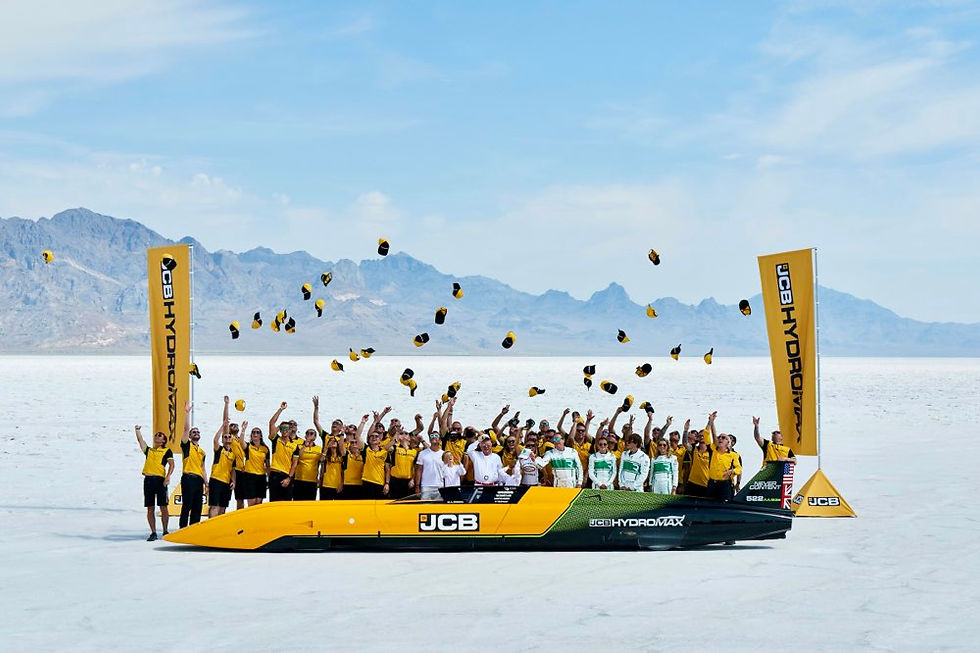
Ballymena bus manufacturer Wrightbus has played a supporting role in a remarkable feat of British engineering after a hydrogen-powered supercar smashed a world land speed record at more than 406mph.
Wrightbus owner Jo Bamford CBE said expertise developed through almost a decade of hydrogen work helped provide the refuelling infrastructure behind the JCB Hydromax, which reached an average speed of 406.320mph on the Bonneville Salt Flats in Utah on Tuesday, 11 August.
The achievement gives the Ballymena connection particular significance: technology and expertise developed as part of the wider hydrogen industry in which Wrightbus has become a major player helped support a vehicle travelling faster than any hydrogen-powered vehicle in history.
Two runs average more than 406mph
Under FIA rules, the JCB Hydromax had to complete two runs in opposite directions within an hour.
It recorded 400.623mph on its first run before reaching 412.135mph on the second, producing the official average of 406.320mph.
The record comfortably surpassed the previous FIA-officiated hydrogen internal combustion benchmark of 185.5mph, set by the BMW H2R in 2004.
Mr Bamford, who bought Wrightbus out of administration in 2019, said he was “extremely proud” of the role his teams had played.
“We have just witnessed a landmark feat of British engineering in one of the most inhospitable places on the planet.
“Our tube trailers and refuellers have been onsite to provide fuel for the JCB Hydromax throughout its testing and development, leading up to today’s record run, and our engineers have worked tirelessly with JCB’s team to ensure the right safety protocols have been in place from day one.
“It’s an incredible team effort which shows the power of our team at Ryze, the power of collaboration and ultimately the power of hydrogen.”
Hydrogen expertise developed over almost a decade
The record comes as Wrightbus continues to develop and manufacture zero-emission buses at its Ballymena operation, including hydrogen-powered vehicles.
The company built what it describes as the world’s first hydrogen double-decker bus, and Mr Bamford said lessons learned during almost a decade of hydrogen development had contributed to the expertise behind the record attempt.
He added:
“Today the world has sat up and taken notice but every single day our teams at Wrightbus, Ryze, JCB and HyKit are on the road selling a complete hydrogen solution to customers - hydrogen fuel, refuelling equipment and hydrogen machines.”
While the record was set thousands of miles from Ballymena, the involvement of Wrightbus and the wider Bamford hydrogen businesses provides another showcase for technology in a sector closely associated with the town’s manufacturing base.
JCB beats its own 20-year benchmark
The Hydromax also broke a record set by JCB itself almost exactly 20 years ago.
In August 2006, JCB Dieselmax reached 350.092mph at Bonneville, setting the world diesel land speed record. The same man who drove that vehicle, Wing Commander Andy Green OBE, was behind the wheel of the Hydromax.
JCB Chairman Anthony Bamford said:
“Twenty years ago we came to Bonneville with JCB Dieselmax and showed what British engineering could do with diesel power. Today we have done it again — this time with engines powered by hydrogen.
“This record was set by production-based engines, the same engines powering JCB diggers right now. That is the point of JCB Hydromax: it shows hydrogen works, and it works today at the highest level with zero emissions.”
The 32-foot, twin-engined Hydromax used two of JCB’s production-based hydrogen digger engines, manufactured at the company’s engine factory in Foston, Derbyshire.
Together they produced around 1,600bhp.
The engines are also being used in JCB machinery entering production in the UK as part of the company’s £100 million hydrogen programme.
Unlike the diesel-powered record car of 2006, JCB says its hydrogen combustion engines produce no CO₂ at the tailpipe.
‘The car was terrific’
For Andy Green, the achievement adds another entry to an extraordinary land-speed record career.
He remains the fastest person on land, having reached 763.035mph, and is the only person to have broken the sound barrier in a car.
Following Tuesday’s runs, he said:
“Bonneville is the spiritual home of the world land speed record, and JCB Hydromax has just written itself into that history. The car was terrific — stable, strong and fast.
“Setting a world land speed record with hydrogen power, twenty years after Dieselmax, is a huge privilege. This record is a huge achievement by a world class team and superb technology.”
The 2006 Dieselmax record of 350.092mph remains the FIA world diesel land speed record. Twenty years later, Green and JCB have now travelled faster on the same Utah salt using hydrogen — with Wrightbus-linked refuelling expertise helping make the record attempt possible.


