


What lies beneath Mountsandel? Archaeologists to share findings from new survey of Ireland’s ancient settlement site


Aerial view of Mountsandel, Coleraine
Friday 20 November 2026
New evidence about the archaeological potential of one of Ireland’s earliest known settlement sites will be presented to the public in Coleraine next week, following a major investigation at Mountsandel earlier this year.
Professor Graeme Warren of University College Dublin (UCD) will reveal preliminary findings from a June 2026 survey at a free public talk on Wednesday 25 November, offering an insight into what may still lie beneath the ground at the internationally important prehistoric site.
The research brought specialists from UCD and Ghent University in Belgium to Mountsandel, where they used modern surveying technology to investigate underground deposits without undertaking extensive excavation.
Exploring thousands of years of history
Mountsandel Wood, overlooking the River Bann in Coleraine, is recognised as the location of the earliest known human settlement in Ireland, with evidence of occupation dating to approximately 7900–7600 BC.
Archaeological discoveries at the site have included flint tools associated with Mesolithic hunter-gatherers, who are believed to have used the area as a seasonal camp, taking advantage of the river and its natural salmon fishing opportunities.
The site provides an important window into how some of Ireland’s earliest inhabitants lived, gathered food and adapted to their surroundings thousands of years before farming became established.
Mountsandel also contains an earthen fortification believed to date from Norman times, reflecting a much later chapter in the area's history.
New technology investigates what lies underground
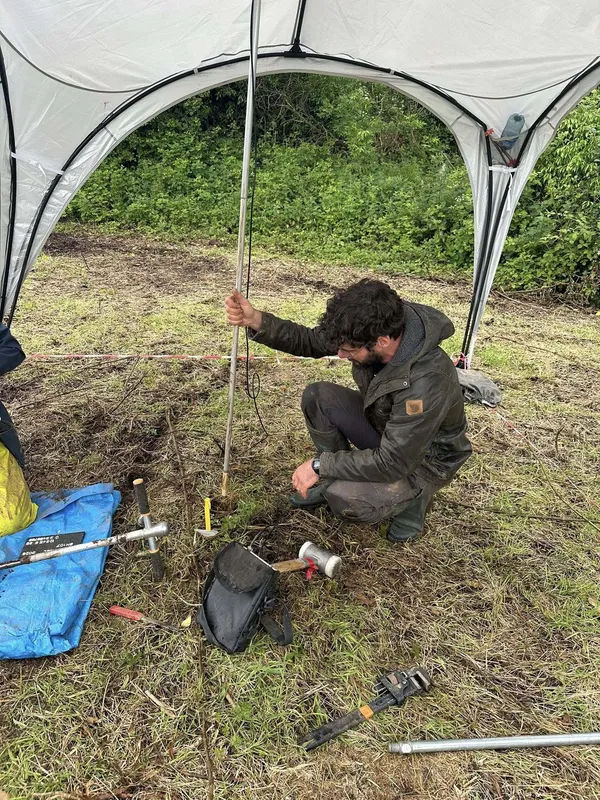
Fieldwork undertaken in June 2026 at Mountsandel, Coleraine.
During fieldwork in early June, the international research team employed four different non-invasive geophysical survey techniques to examine variations in the deposits beneath the site.
Methods included electromagnetic surveying, magnetometry and ground-penetrating radar, which allow archaeologists to investigate potential buried features by measuring differences in the physical properties of the ground.
The surveys were supplemented by minimally invasive borehole sampling, enabling researchers to collect sediment samples and record underground deposits.
Together, the investigations have generated new information about Mountsandel's archaeological potential and established baseline evidence to help researchers assess what further discoveries the site might hold.
The findings to be presented are preliminary, with the public talk providing an opportunity to hear what the investigations have established so far and how they may contribute to future research.
Lead archaeologist to explain the discoveries
Professor Warren, a member of the Royal Irish Academy and a specialist in early prehistory and hunter-gatherer archaeology, led the June investigation.
At the event, entitled ‘Mountsandel Revisited’, he will explain the research methods, discuss the preliminary results and explore their significance for understanding the site's prehistoric past.
The survey attracted considerable local interest, and the event will give residents, history enthusiasts and those interested in archaeology an opportunity to hear directly from the archaeologist leading the work.
The talk is being organised by Causeway Coast and Glens Museum Services in partnership with Mountsandel Discovery & Heritage Group.
How to attend the free public talk
‘Mountsandel Revisited’ is open to everyone interested in local history, archaeology and heritage.
• Date: Wednesday 25 November 2026
• Time: 7pm
• Venue: Ulster University, Coleraine
• Admission: Free
• Booking: Through Eventbrite, by emailing museums@causewaycoastandglens.gov.uk or by telephoning Ballymoney Visitor Information Centre on 028 2766 0230
The archaeological project forms part of the wider Causeway Coast and Glens PEACEPLUS Action Plan, supported by PEACEPLUS and managed by the Special EU Programmes Body (SEUPB).
For those interested in the earliest chapters of Ireland's history, Wednesday's event offers a chance to discover what modern archaeological techniques are revealing about Mountsandel and the potential for further discoveries at a site occupied almost 10,000 years ago.


