RTÉ’s ‘Masters: Keepers of Tradition’ shines spotlight on Ireland’s vanishing crafts as landmark series begins
- Love Ballymena

- 2 days ago
- 5 min read
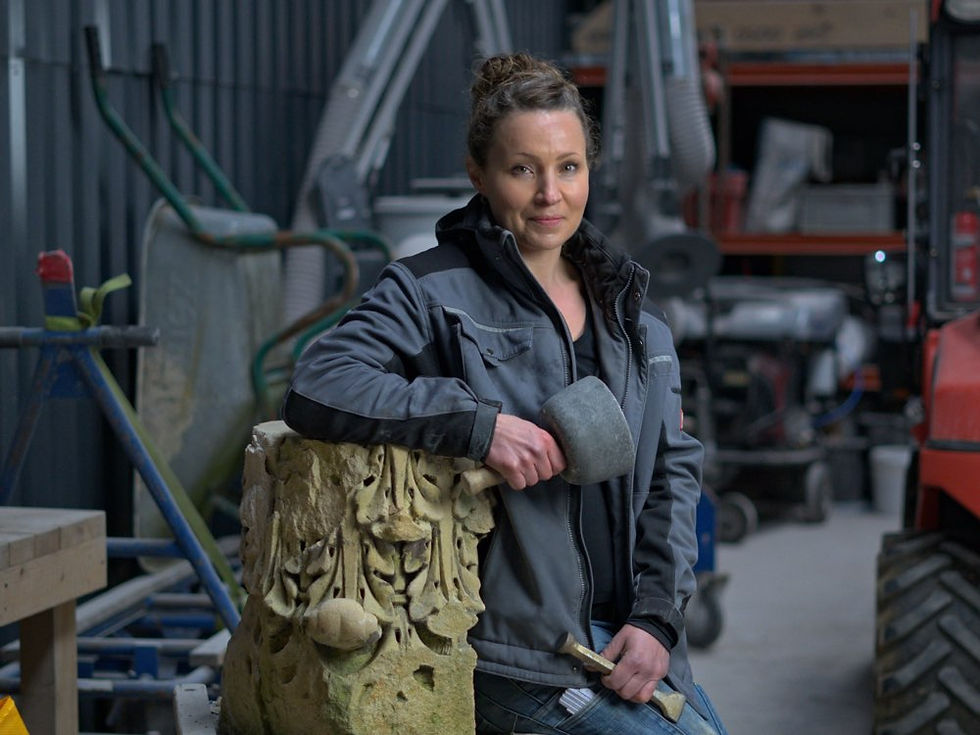
Stonemason Julia Gebel, based in Tipperary
A major new RTÉ documentary series is set to bring Ireland’s fading traditional crafts back into sharp focus, revealing the lives, pressures and passion behind skills that risk disappearing in a fast-moving, digital-first world.
Launching on Monday, April 27 at 8:30pm on RTÉ One and RTÉ Player, Masters: Keepers of Tradition explores six rare crafts through the personal stories of the people who have dedicated their lives to preserving them—at a time when the survival of these traditions faces growing uncertainty.
The six-part series arrives with a clear mission: to reconnect audiences with hands-on making, highlight the real-world value of artisanal expertise, and inspire a new generation to carry forward skills that have shaped Irish identity for centuries.
A modern revival of a classic Irish storytelling format
Inspired by the iconic RTÉ series Hands, first broadcast in the late 1970s, Masters: Keepers of Tradition revisits a format that once offered a powerful window into the lives of craftspeople across Ireland.
But this new series moves beyond demonstration, placing equal weight on the human stories behind the craft—exploring motivation, personal sacrifice, family influence, and the environments that shape each artisan’s work.

Basket weaver Joe Hogan from Lough na Fooey
Each episode follows a craftsperson as they undertake a real commission, allowing viewers to see not only the technical process, but also the emotional and social impact when the finished piece is delivered.
The series is produced by Tiny Big Films Ltd, with support from The Heritage Council and Coimisiún na Meán, marking it as a significant cultural project aimed at preserving and promoting Ireland’s intangible heritage.
Six crafts, six lives, one shared purpose

Cork-based clockmaker Philip Stokes
Across the series, viewers will meet a diverse group of craftspeople whose work spans generations, continents, and disciplines:
Stonemason Julia Gebel, based in Tipperary
Handweaver Beth Moran on Clare Island
Basket weaver Joe Hogan from Lough na Fooey
Cork-based clockmaker Philip Stokes
Blacksmith John Hogan working at Westport House in Co. Mayo
Thatcher Marika Leen in rural Galway

Thatcher Marika Leen in rural Galway
Each story reflects a different route into craft—some through formal training, others through instinct, chance, or necessity—but all share a commitment to preserving skills that are increasingly rare.
Opening episode: a race against time in stone
The series opens with stonemason Julia Gebel, whose journey to Ireland began with a restoration project at the Rock of Cashel and became a lifelong commitment.
Originally from Germany, she arrived to work on Cormac’s Chapel—an ancient seat of the Kings of Munster—and remained for four years, including the final seven months while pregnant and still climbing scaffolding.
She never returned home.

Stonemason Julia Gebel, based in Tipperary
Now living in Tipperary with her children, Etta and Dillon, Gebel has established one of Ireland’s leading stone and building conservation companies alongside her business partner, Christian Helling.
In the opening episode, she faces one of her most demanding challenges since her college days: carving a bust of Irish revolutionary Dick Barrett to mark the centenary of his reinterment from Mountjoy Prison, following his unlawful execution in 1922.
Working from a clay model and using the technically demanding lost-form process, she has just 22 days to carve Barrett’s likeness from a block of Kilkenny blue limestone sourced from the historic Threecastles quarry.
As the face gradually emerges from the stone, the commission becomes more than a technical exercise—prompting reflection on identity, sacrifice, and the importance of passing historical understanding to the next generation.
Craft under pressure in a changing world

Blacksmith John Hogan working at Westport House in Co. Mayo
At its core, the series highlights a growing tension: traditional skills that once thrived in local economies are now under pressure from industrialisation, changing lifestyles, and a decline in apprenticeships.
Colm Crowley, Head of RTÉ Cork, said the series offers a counterpoint to modern life.
“In an always-online world, this series offers a powerful alternative. Masters: Keepers of Tradition celebrates creativity that’s hands-on, patient and deeply meaningful — showing younger audiences that fulfilment can be found in making, learning and contributing something lasting to the world around them.”
Virginia Teehan, Chief Executive of The Heritage Council, said the series addresses a long-standing gap in public awareness.
“This beautiful series shines a light on the dedication behind crafts that are part of our shared heritage but are often overlooked. It brings these skilled craftspeople and their work back into the public consciousness, showing that these traditions are very much alive today.
“At the Heritage Council, we have long supported practitioners of traditional skills, and this series reflects the importance of continuing that work. By telling these stories, we hope to inspire a new generation to learn these crafts and carry them forward.”
National effort to safeguard traditional skills

Handweaver Beth Moran on Clare Island
The series also reflects wider efforts to protect Ireland’s traditional skills sector, led in part by The Heritage Council, the country’s statutory body for heritage protection established in 1995.
In recent years, the Council has expanded its work through targeted initiatives, including:
• Launching Ireland’s first thatch training course in 15 years in partnership with Kilkenny Carlow Education and Training Board
• Establishing the All-Ireland Heritage Skills Programme in collaboration with The King’s Foundation and the Department for Communities’ Historic Environment Division, aimed at developing expert-level craft skills within the construction sector
• Forming a working group to develop a Centre of Excellence for Traditional Skills, identified as a commitment in the Programme for Government
Alongside these initiatives, the Council continues to support communities, local authorities, and heritage projects through grants, education programmes, conservation guidance, and public engagement events such as Heritage Week.
A timely reminder of what could be lost—and what can still be saved
By placing individual stories at the heart of a broader national conversation, Masters: Keepers of Tradition underscores what is at stake if these crafts fade away—not just the loss of skills, but the erosion of cultural memory, identity, and community connection.
Through six lives shaped by dedication, risk, and resilience, the series makes a clear case that traditional craftsmanship is not a relic of the past, but a living, evolving part of Ireland’s future.
At a glance
• New RTÉ series Masters: Keepers of Tradition begins Monday, April 27 at 8:30pm
• Six-part documentary focuses on rare and traditional Irish crafts
• Inspired by the 1970s RTÉ series Hands
• Each episode follows a craftsperson completing a real commission
• Featured crafts include stonemasonry, weaving, basket making, horology, blacksmithing and thatching
• Opening episode follows Julia Gebel carving a bust of Dick Barrett in just 22 days
• Series supported by The Heritage Council and Coimisiún na Meán
• Aims to inspire younger generations to learn traditional skills
• Highlights national efforts to preserve endangered crafts