


Chancellor promises ‘growth in every postcode’ as Northern Ireland businesses put at heart of UK economic drive


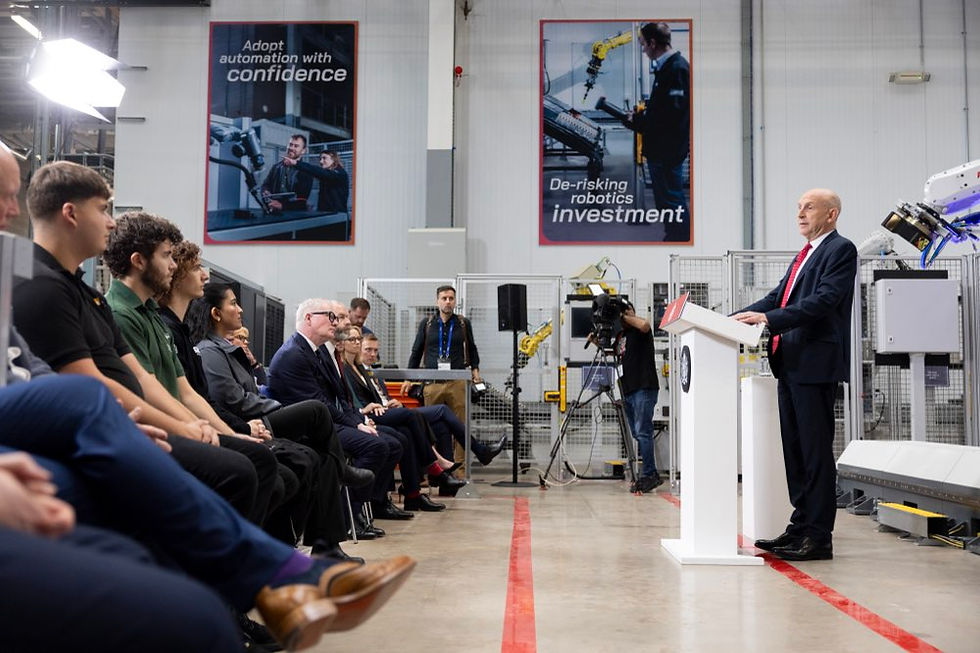
Chancellor John Healey delivers a growth speech at the Manufacturing Technology Centre in Coventry. (Pictures by Kirsty O'Connor / Treasury)
Northern Ireland businesses could benefit from a major shift in how the UK Government directs investment, awards public contracts and assesses infrastructure projects, as Chancellor John Healey pledged to pursue economic growth “in every postcode”.
In a wide-ranging speech on Monday (August 7), Mr Healey said investment in Northern Ireland small businesses through the British Business Bank would form part of a UK-wide push to spread economic growth beyond its traditional centres.
But the significance for Northern Ireland extends beyond business finance. Changes announced by the Chancellor could influence which infrastructure projects secure government backing, while he also wants more of the public sector’s spending power used to support British firms.
A different test for government investment
One of the most consequential changes is to the Treasury’s Green Book — the framework used to assess the value of government policies, programmes and investment projects.
Mr Healey said the Treasury’s discount rate would be reduced from 3.5% to 3%, a change intended to give greater weight to projects offering benefits over a longer period.
He said the Government would also introduce “economic potential analysis”, designed to assess areas not simply on their economy today, but on what they could become.
The Chancellor said:
“That will skew investment towards projects with more long-term potential, meaning that more places across the UK will get a fair hearing.”
For areas outside the UK’s strongest economic centres, that could prove significant. The test, however, will be whether the changes ultimately translate into investment decisions and projects on the ground.
Northern Ireland singled out in UK growth plans
Setting out his plans to spread economic activity more widely, Mr Healey said the Government wanted to put more power and resources in the hands of local leaders to support infrastructure, private investment and locally driven economic strategies.
He pointed specifically to existing British Business Bank activity in Northern Ireland.
“Across all nations of the UK, we will support local leaders to deliver local growth,” he said.
“And as the UK Government we’ve already begun this work with those nations — making Aberdeen the home of GB Energy, making major investment in Welsh railways, and making investments in small businesses across Northern Ireland again through the British Business Bank.”
The Chancellor did not announce a new Northern Ireland-specific funding allocation in the speech. By contrast, he confirmed a new £150 million British Business Bank allocation for fast-growing companies in the North of England.
That distinction matters: while Northern Ireland was explicitly included in the Government’s wider growth strategy, Monday’s speech did not attach a new cash figure to its commitment here.
Public contracts could be used to back businesses
The Government also intends to make greater use of the enormous purchasing power of the public sector.
Mr Healey said he would sharpen the focus of publicly backed financial institutions — which he said are already backed by £200 billion — to align them more closely with government priorities.
He also pledged to use “public procurement as a strategic tool, to ensure that we back British firms across more of the public sector”.
The detail of how that policy will operate — and how it will apply within Northern Ireland’s devolved public sector and existing procurement rules — will be important in determining its practical significance for businesses here.
For local manufacturers and other firms competing for public contracts, the eventual rules could potentially create opportunities, but Monday’s speech did not set out the detailed eligibility or procurement arrangements.
Government promises to cut regulatory burden

The Chancellor also acknowledged concerns over the pressures facing businesses, citing energy bills, regulation, planning constraints and labour costs.
“I want to draw the line,” he said.
Mr Healey reaffirmed a commitment to reduce the burden of business regulation by 25% by the end of the current Parliament.
Judicial review reforms already being pursued for energy projects will also be extended to all major infrastructure, while the Chancellor said the Government would examine where regulators may be holding businesses back.
Business Secretary Johnny Reynolds and the Chancellor are expected to convene major regulators later this autumn, ahead of the Spending Review, to identify possible changes.
Investment, innovation and jobs
The Chancellor identified investment, innovation and employment as the three main drivers of the Government’s growth strategy.
He said business investment had risen by 4.9% since the election, but argued that Britain continued to suffer from historically weak investment.
On innovation, the Government is setting an ambition to double the number of UK “unicorns” — privately owned start-up businesses valued at more than $1 billion.
It also wants government to become an early customer for promising British companies, helping businesses developed in the UK to grow here rather than seeking investment elsewhere.
New “sandboxing” powers are intended to be ready for use across the economy next year, allowing businesses to test emerging technologies under controlled regulatory conditions.
Mr Healey cited technology ranging from pavement robots and drones to new medical treatments.
AI opportunity — but Chancellor acknowledges risks
Artificial intelligence also featured prominently, with the Chancellor arguing that it could affect “every firm, every community, every hospital, every school”.
However, he acknowledged concerns about its impact on jobs, resources and security.
“As Chancellor, I will not let this opportunity of AI pass Britain by, but nor will I allow this technology to proceed with no oversight,” he said.
The Government’s challenge will be translating technological investment into productivity and employment gains across regions including Northern Ireland, rather than allowing the benefits to become concentrated in established technology centres.
Focus on young people outside work and education
Employment formed the final strand of the Chancellor’s plan.
Mr Healey said nearly one million people aged between 16 and 24 were now not in education, employment or training, with two-thirds having never held a job.
He described tackling youth unemployment as both a “moral duty” and a “fiscal duty”.
Alan Milburn is expected to present recommendations to the Government this autumn on tackling youth unemployment.
The Chancellor also highlighted plans for local leaders to work with employers to shape technical education pathways, giving young people access to technical skills from the age of 14.
What does it mean for Northern Ireland?
For Northern Ireland, Monday’s speech is more a statement of economic direction than a package of immediately available new funding.
There are nevertheless potentially important changes beneath the headline promises.
A new approach to assessing long-term infrastructure investment could affect how projects outside Britain’s strongest economies compete for government support. Greater use of public procurement could create opportunities for businesses, while British Business Bank investment remains part of the Government’s stated approach to supporting Northern Ireland firms.
The Chancellor also made clear that tighter control of public spending will sit alongside the growth agenda, arguing that fiscal discipline is necessary as the Government prepares for its forthcoming Budget.
Mr Healey said debt interest now accounts for £1 in every £10 of government spending and reiterated a commitment to balancing the books with a financial buffer, controlling borrowing and reducing longer-term pressure on the public finances.
The real test for Northern Ireland will therefore come in the Budget and subsequent spending and investment decisions: whether the promise of “growth in every postcode” results in additional investment, contracts and jobs here — and how much of the new economic model extends beyond England’s mayoral regions.
The Chancellor said:
“We will not deliver all this tomorrow. But we’re delivering the start of it today.”
He added that the approach would guide the Government through the Budget, the Prime Minister’s 10 Year Plan and the remainder of the Parliament.


