Jim Allister calls for stronger Royal Navy presence in NI as HMS Queen Elizabeth arrives in Belfast

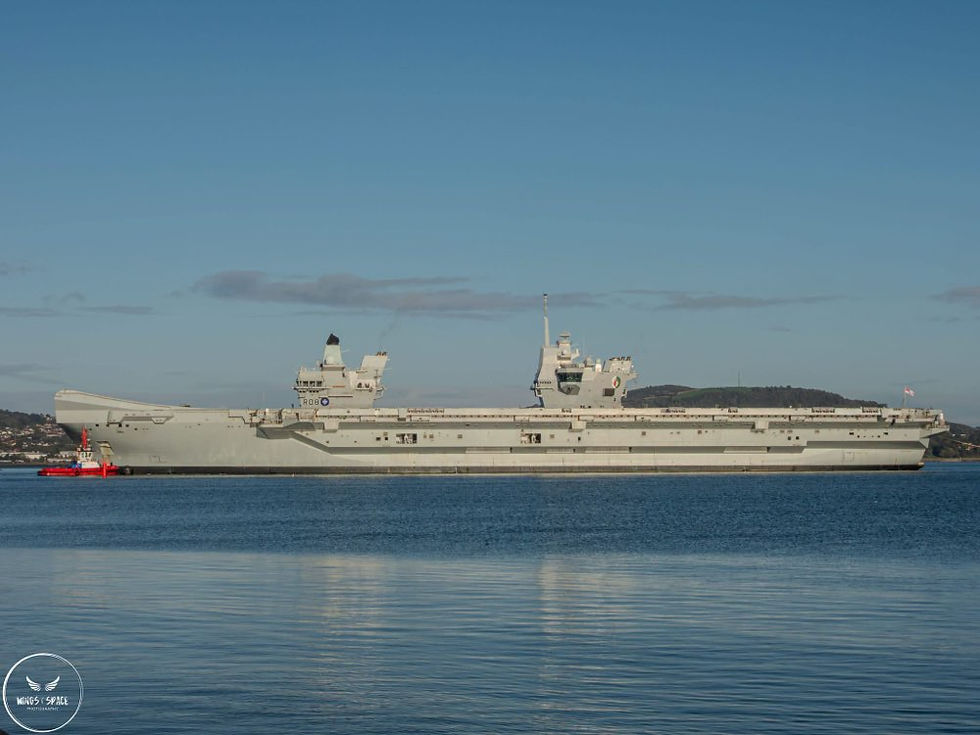
HMS Queen Elizabeth sailing into Belfast on Wednesday morning. (Photo: Michael Luke)
Wednesday 07 October 2026
The arrival of HMS Queen Elizabeth in Belfast has prompted TUV leader Jim Allister to call for a significantly stronger permanent Royal Navy presence in Northern Ireland, arguing its strategic importance has grown amid heightened security concerns in the North Atlantic.
The 65,000-tonne aircraft carrier sailed into Belfast on Wednesday morning, marking the first visit by a Royal Navy aircraft carrier to Northern Ireland in more than 60 years.
HMS Queen Elizabeth is currently serving as NATO’s Afloat Command Platform for the Allied Reaction Force (Maritime) and is undertaking planned training around the UK and northern Europe with a crew of more than 800 sailors.
Allister calls for permanent naval presence
Mr Allister used the high-profile visit to question what he described as an “almost non-existent” permanent naval presence in Northern Ireland.
“The arrival of one of the UK’s greatest defence assets in Northern Ireland today affords an opportunity to highlight the special geo-strategic significance of Northern Ireland to the defence of the United Kingdom.”
He said Northern Ireland had played an important role in the defence of the UK and Western Europe during the Second World War and argued that its geographic position was becoming increasingly significant again.
“In this context I am deeply concerned that when, after reading the Policy Exchange document, I tabled a written parliamentary question on the permanent naval presence in Northern Ireland, I discovered it is almost non-existent.”
Mr Allister said the response showed that between the Royal Navy and Royal Marines only five full-time service personnel are based in Northern Ireland.
“This is not remotely credible and must change both for the benefit of the people of Northern Ireland and the wider United Kingdom.”
Strategic importance of Northern Ireland

TUV Party Leader and North Antrim MP Jim Allister
The North Antrim MP pointed to a Policy Exchange report, ‘Rediscovering Northern Ireland’s Role in British National Security’, which examines Northern Ireland’s potential strategic importance amid changing security threats.
In its foreword, former First Sea Lord and former Security Minister Admiral Lord West of Spithead wrote:
“There is no doubt that for reasons of geography the island of Ireland has considerable strategic importance to the UK and NATO. The Western Approaches and wider Atlantic and Arctic oceans and their sea-beds have become the front line in the grey war that Russia is waging.
“To counter this we need bases ‘up threat’, which means West of the UK mainland, should hot war break out bases in Northern Ireland become even more crucial.”
Mr Allister also highlighted Northern Ireland’s role during the Second World War, including the presence of US forces ahead of the Allied invasion of Europe.
Quoting General Dwight D Eisenhower, who later became US President, he said:
“Without Northern Ireland, I do not see how the American Forces could have concentrated to begin the invasion of Europe. If Ulster had not been a definite co-operative part of the British Empire and had not been available for our use, I do not see how the build-up could have been carried out in England.”
Historic Belfast visit
HMS Queen Elizabeth is one of two Queen Elizabeth-class aircraft carriers operated by the Royal Navy and is capable of carrying up to 40 aircraft. The ship returned to the fleet earlier this year following extensive engineering work at Rosyth.
Its Belfast visit comes as the Royal Navy leads NATO’s Allied Reaction Force maritime component for a 12-month period, with HMS Queen Elizabeth acting as the command platform from which naval operations can be coordinated if the force is activated.
For Belfast, the carrier’s arrival is also a significant maritime occasion in its own right — bringing a Royal Navy aircraft carrier into the city for the first time since 1965 while placing renewed attention on Northern Ireland’s role in UK and NATO defence.