


Families gather in Co Antrim to honour forgotten heroes of the Yangtze incident with memorial plaque

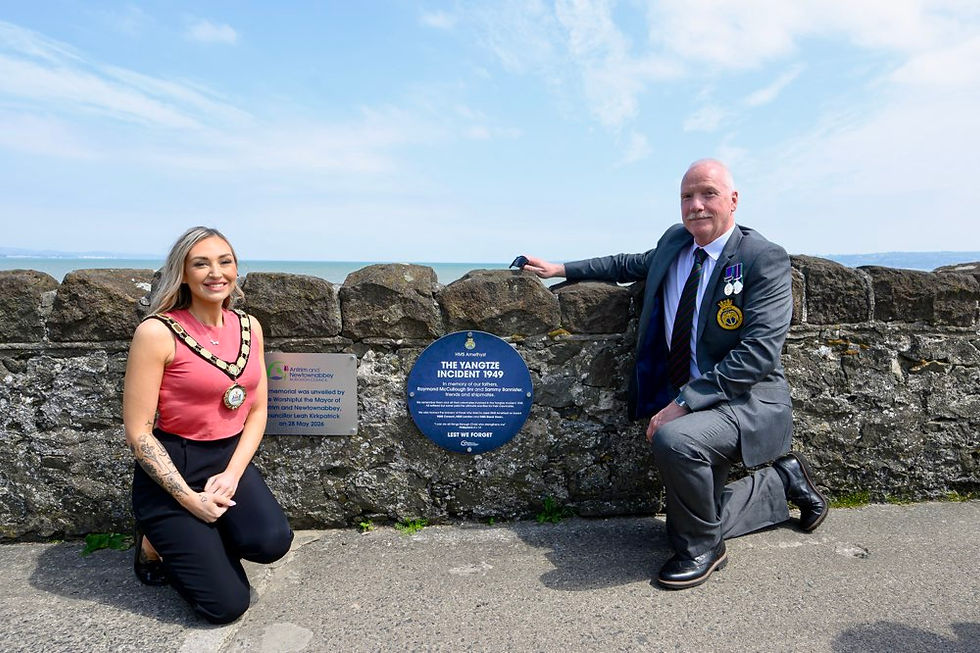
Mayor of Antrim and Newtownabbey Councillor Leah Kirkpatrick pictured alongside the son of Stoker Sammy Bannister, Andy Bannister at a special memorial plaque at Hazelbank Park.
A deeply personal chapter of Northern Ireland’s naval history has been permanently commemorated in County Antrim following the unveiling of a new memorial honouring local sailors caught up in one of the Royal Navy’s most dramatic post-war incidents.
Family members travelled from across the UK and beyond this week as a memorial plaque and storyboard dedicated to Northern Ireland sailors involved in the 1949 Yangtze Incident were officially unveiled at Macedon Point.
Macedon Point, where the memorial is located, is a scenic headland and popular public amenity along the Loughshore Path within Hazelbank Park in Newtownabbey. Overlooking Belfast Lough, the site offers sweeping panoramic views stretching from Belfast across to the County Down coastline, providing a striking and reflective setting for the tribute to those involved in the Yangtze Incident
The memorial recognises the courage and suffering of those aboard HMS Amethyst after the Royal Navy frigate came under sustained attack on China’s Yangtze River during the Chinese Civil War — an incident which left 27 crew members dead and many others seriously injured.
Among those caught in the attack were two young Belfast sailors — Stoker Sammy Bannister and Able Seaman Raymond McCullough — whose experiences became central to a decades-long effort to ensure the story was not forgotten.
Campaign driven by sons of Belfast sailors

(L-R): Andy Bannister, Mayor of Antrim and Newtownabbey Councillor Leah Kirkpatrick, Deputy Mayor, Councillor Julie Gilmour and Raymond McCullough at the official unveiling of a memorial commemorating the Yangtze Incident.
The memorial is the result of determined campaigning by Andy Bannister and Raymond McCullough Jnr, whose fathers both served aboard HMS Amethyst during the crisis.
Their efforts culminated this week in an emotional unveiling ceremony led by the Mayor of Antrim and Newtownabbey, Councillor Leah Kirkpatrick.
Relatives of sailors involved in the incident gathered to share memories, family stories and reflections on the lasting impact the ordeal had on those who survived.
For many families, the event represented long-overdue recognition for men who carried the trauma of the Yangtze Incident quietly for the rest of their lives.
Attack on HMS Amethyst left sailors trapped for months
On 20 April 1949, HMS Amethyst was carrying out what were described as lawful duties on the Yangtze River when the vessel came under intense attack from Communist forces during the Chinese Civil War.
The frigate was repeatedly shelled, leaving dozens dead or wounded as the ship ran aground under heavy bombardment.
Attempts by HMS London, HMS Black Swan and HMS Consort to reach and assist the vessel failed, leaving the crew isolated and exposed on the river.
Stoker Sammy Bannister suffered serious shrapnel wounds during the attack. Despite his injuries, he managed to leave the ship in an attempt to escape before being captured by Communist forces.
Emergency surgery ultimately saved his life.
Able Seaman Raymond McCullough was initially feared missing in the chaos following the bombardment before later being discovered aboard the vessel helping care for wounded crew members.
Three months under siege before daring escape
Following Bannister’s return to HMS Amethyst, the crew effectively remained trapped on the Yangtze River for more than three months.
During that period, sailors worked to repair the heavily damaged vessel while living under constant threat as negotiations and tensions continued around them.
The ordeal finally came to an end on the night of 30 July 1949 when HMS Amethyst made a daring escape attempt under darkness and successfully sailed to safety.
The incident later became one of the most famous naval episodes of the post-war era and inspired books, documentaries and the 1957 film The Yangtse Incident: The Story of HMS Amethyst.
Families remember the lasting impact

Family members of the Northern Ireland sailors on-board HMS Amethyst, who have travelled from near and far to see the memorial unveiled.
While many sailors eventually returned home, the emotional and physical toll of the incident endured long after the headlines faded.
Some survivors later went on to serve during the Korean War, while families say many rarely spoke openly about what they had experienced.
Speaking at the unveiling, Councillor Leah Kirkpatrick said the ceremony was an important opportunity to recognise both sacrifice and resilience.
“It was a privilege to unveil this memorial and meet some of the families whose loved ones it honours,” she said.
“We pay tribute to all who served, those who lost their lives and those who lived with the lasting impact of their experiences.”
New memorial now open to the public
The newly installed storyboard at Macedon Point provides visitors with a detailed account of the Yangtze Incident and the experiences of those aboard HMS Amethyst.
For the families behind the campaign, the memorial ensures the story of the Belfast sailors — and the wider sacrifice of the crew — now has a permanent public place in Northern Ireland’s history.


