Chief Constable warns policing is at breaking point amid £149m funding gap as PSNI marks 25 years

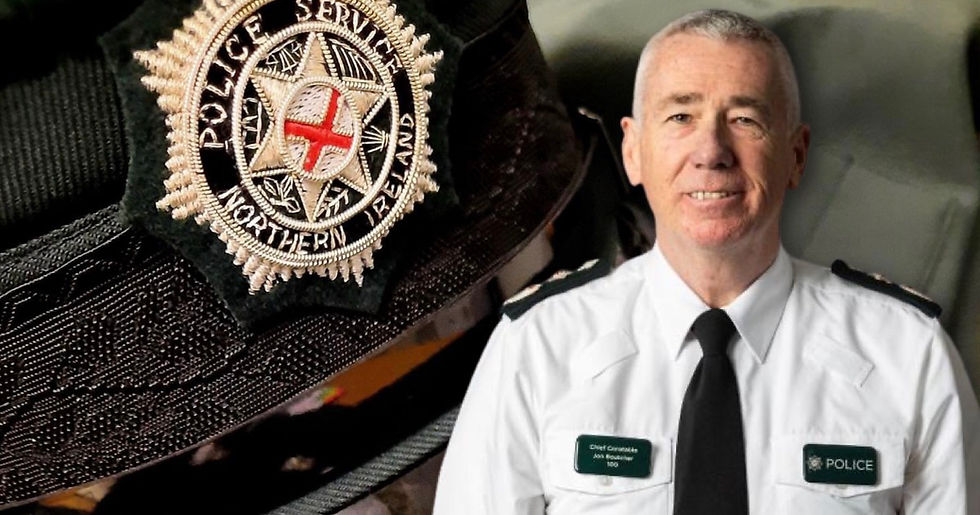
Chief Constable of the Police Service of Northern Ireland, Jon Boutcher
The Chief Constable of the Police Service of Northern Ireland has issued one of his starkest warnings yet over the future of policing, saying the PSNI is facing a “dangerous” financial crisis that risks undermining frontline services, neighbourhood policing and support for victims.
Jon Boutcher said the organisation remains “structurally underfunded” and revealed projected shortfalls of around £57 million, £92 million and £149 million over the next three years — despite Northern Ireland still facing ongoing paramilitary threats, legacy investigations and rising public safety pressures.
His comments came after a new House of Commons Northern Ireland Affairs Committee report on policing and security in Northern Ireland, which examined the financial pressures, recruitment challenges and legacy burdens facing the PSNI as it approaches its 25th anniversary.
For communities across Northern Ireland — including Ballymena and Mid and East Antrim — the warning raises serious questions about the future of everyday policing services, response times, neighbourhood patrols and the PSNI’s ability to tackle organised crime, anti-social behaviour and violence against women and girls.
Chief Constable says current situation ‘cannot continue’
Mr Boutcher welcomed the Westminster committee’s findings but said the report had become dominated by concerns over policing finances because of the scale of the crisis now facing the service.
“As we approach the 25th anniversary of the PSNI, I believe this inquiry is an incredibly welcome report from a respected committee that provides yet another opportunity to take stock of the perilous financial situation the PSNI has been placed in,” he said.
“Everyone in Northern Ireland and indeed beyond our borders should be concerned about the way police funding in Northern Ireland has failed to keep pace with other public services.”
The Chief Constable said there needed to be a “watershed moment” for policing funding and warned the PSNI could not continue operating under current financial pressures.
“It is our outstanding workforce that has kept the ship afloat but this cannot be expected to continue,” he said.
Mr Boutcher also highlighted the fact that, despite the new financial year already being underway, the PSNI still does not have an agreed budget.
“Two months into the new financial year we still don’t have an agreed budget and are staring down the barrel of projected shortfalls of roughly £57m, £92m and £149m over the next three years,” he said.
Legacy costs draining frontline policing budget
A major focus of the Chief Constable’s intervention was the financial burden of legacy investigations linked to the Troubles.
Mr Boutcher said legacy-related work currently costs the PSNI around £24 million every year, with that money coming directly from core policing budgets intended for frontline services.
He warned that officers dealing with neighbourhood policing, emergency response calls, violence against women and girls, and organised criminal gangs were all being impacted because funding was being diverted into historical cases.
“Money that should be spent on policing today is being spent on the past,” he said.
“This has to stop. We cannot continue to provide money for legacy, when it should be spent on policing and keeping Northern Ireland safe today.”
The Chief Constable also criticised what he described as a lack of political responsibility around funding legacy-related work.
“There has been no proper planning or forecasting of legacy costs on the PSNI,” he said.
“Indeed the opposite is the case; when I suggest such discussions about legacy funding I get pushed from pillar to post with no political responsibility being taken to support the organisation in dealing with these increasing costs.”
He warned the issue was also affecting public trust and confidence, particularly among victims waiting for answers.
Concerns raised over Troubles legacy legislation
Mr Boutcher also voiced strong concerns over elements of the Government’s proposed Troubles legislation and the practical demands it could place on the PSNI.
He said proposals surrounding the handling and categorisation of legacy documents were “entirely unworkable” and warned the current direction of travel could cause the entire process to “collapse”.
“The requirements of the proposed Schedule 4 of the Troubles Bill are entirely unworkable,” he said.
“It is not for the PSNI to categorise documents from a security perspective or determine if those documents are prejudicial.”
Instead, he argued that legacy records held by the PSNI should be directly accessible to the Legacy Commission and that a funded programme should be introduced to digitise records and improve access.
Mr Boutcher said this would help reduce pressure on the PSNI while improving confidence among victims and families affected by Troubles-related cases.
Recruitment pressures and representation challenges
The Chief Constable also acknowledged ongoing recruitment challenges and the need to increase representation from communities currently under-represented within policing.
He said the PSNI was introducing measures aimed at attracting recruits from across all sections of society and pointed to the television series Peelers – The PSNI for Real as one example of efforts to show “the real people behind the uniform”.
“We hope the next series will be released later this year and will be a recruiting tool along with other activities to attract people from across communities to join this brilliant organisation,” he said.
However, he stressed the PSNI could not solve recruitment issues alone.
“This is going to require community and political support and leadership,” he added.
The Chief Constable also referenced the continuing threat posed by dissident republican groups, describing them as “cowards” who had failed to accept that Northern Ireland had moved on.
He said tackling paramilitary criminality remained a key priority for the PSNI and warned such activity continued to create fear in communities across Northern Ireland.
Pressure growing ahead of PSNI’s 25th anniversary
The comments come at a significant moment for policing in Northern Ireland, with the PSNI approaching its 25th anniversary amid mounting political debate over public spending, policing numbers and public confidence.
The House of Commons report examined not only security challenges and legacy pressures, but also the wider transformation of policing since the Patten reforms which led to the creation of the PSNI in 2001.
Mr Boutcher said the organisation remained committed to improving standards and rebuilding confidence where mistakes had been made, but warned meaningful reform and effective policing would not be possible without long-term financial support.
“This organisation will seek to continually improve and put things right that we get wrong, but we need the funding for officers and capital investment for technology to provide the policing that people deserve,” he said.
“Please let this report be the turning point that causes PSNI funding to be addressed.”
The intervention is likely to intensify pressure on Stormont and Westminster over the future funding model for policing in Northern Ireland — particularly as concerns continue to grow over officer numbers, stretched services and the increasing demands being placed on frontline policing.